The core deficiency in most modern villa design Dubai projects isn’t aesthetic; it’s the quantifiable failure to isolate structure-borne vibration, leading to a direct and predictable degradation of asset utility. The asset’s primary function is compromised from day one. We are not discussing comfort. We are discussing the physics of asset performance and its direct correlation to financial valuation. It’s a simple input-output calculation where the input is engineering and the output is sustained capital value.
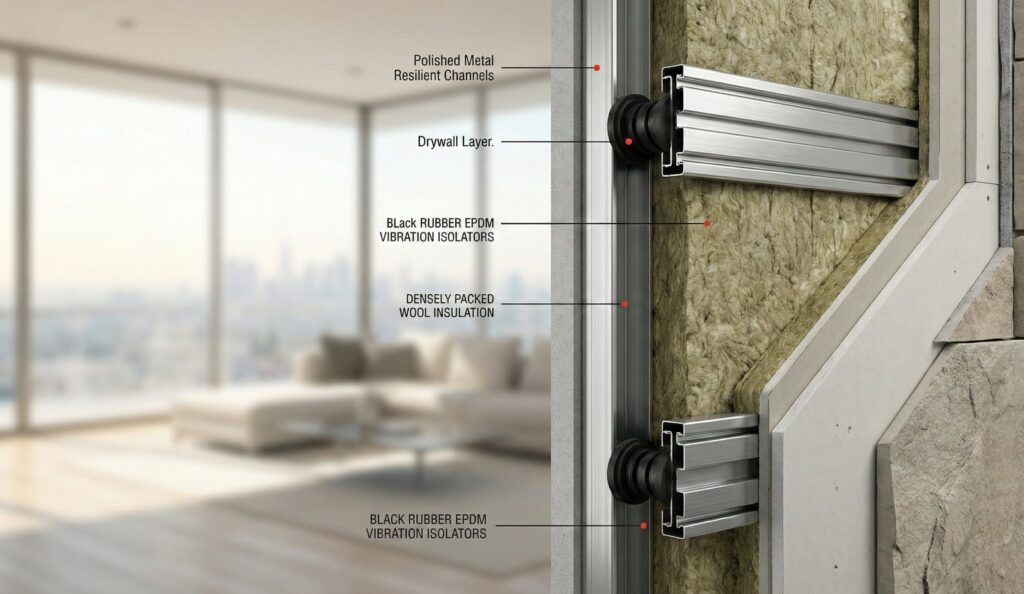
Mastery Analysis: Acoustic Flanking Path Neutralization and Secure-Vibration Isolation
Technically speaking, the conversation about soundproofing is fundamentally flawed. The target isn’t blocking airborne sound; that’s a rudimentary concept. The actual engineering challenge is neutralizing flanking paths—the transmission of acoustic energy through the rigid structure of the building itself. Think of it as a current. It will always follow the path of least resistance. In a concrete and steel villa, that path is the rebar, the studwork, the HVAC ducting, and the plumbing penetrations. A wall assembly with a laboratory-certified Sound Transmission Class (STC) of 65 can perform at a field-tested Noise Isolation Class (NIC) of 48 if a single flanking path is ignored.
This is a catastrophic performance delta. Here is the reality: standard construction practices in the UAE, even those compliant with Dubai Municipality (DM) base codes, actively create these paths by rigidly coupling drywall to concrete blockwork or by failing to acoustically decouple MEP systems from the primary structure. Our protocol mandates a complete structural disconnect. We engineer decoupled wall and ceiling assemblies using kinetically calculated resilient channels, ensuring the load applied does not exceed 80% of the channel’s optimal deflection rating, which prevents the channel from becoming a rigid, ineffective bridge for vibration. For floor assemblies, the focus is on a floating concrete screed resting on high-compressive-strength, low-dynamic-stiffness isolators, creating a system with a natural frequency below the audible human range.

This isn’t a design choice; it’s a physics-based necessity governed by the principles of mass-spring-mass damping. Every penetration for wiring, plumbing, or data is treated as a potential failure point and sealed with a multi-component system: a high-density acoustic putty pad, followed by a non-hardening, permanently flexible acoustic sealant with a specific Shore A hardness between 20-30 to absorb vibration without cracking. These specifications are not arbitrary; they are cross-referenced with Dubai Civil Defence (DCD) requirements for firestopping, ensuring that the acoustic seal also functions as a compliant fire and smoke barrier. The financial impact is direct: eliminating these flanking paths from the initial build prevents future, highly invasive, and expensive remediation, thus preserving the operational integrity and capital value of the asset as specified under FIDIC contract terms.
The Expansion Chapter: The 10-Year Depreciation Cycle, Life-Cycle Costing (LCC), and Maintenance-Free Engineering
An asset’s value is not its purchase price; it’s the net present value of its future utility minus its life-cycle costs. Executives understand this better than anyone. A modern villa in Dubai is a 10-year asset cycle at minimum. Standard acoustic installations are an operational liability masquerading as a capital investment. The numbers don’t lie: low-density foam and cheap recycled rubber isolators used under flooring or in wall cavities exhibit significant material creep and compression set within 36 months in Dubai’s thermal environment.
The physics are simple: the cellular structure of these materials breaks down under constant load and thermal cycling between 20°C indoor and 45°C ambient wall cavity temperatures. This breakdown causes a measurable loss in the material’s damping coefficient, meaning its ability to convert vibrational energy into low-level heat diminishes exponentially. After five years, its performance is negligible. This triggers a requirement for remediation—an unplanned operational expense (OpEx) that directly impacts the asset’s profitability and accelerates its depreciation. Our engineering mandate is to eliminate this entire failure cascade through material science.
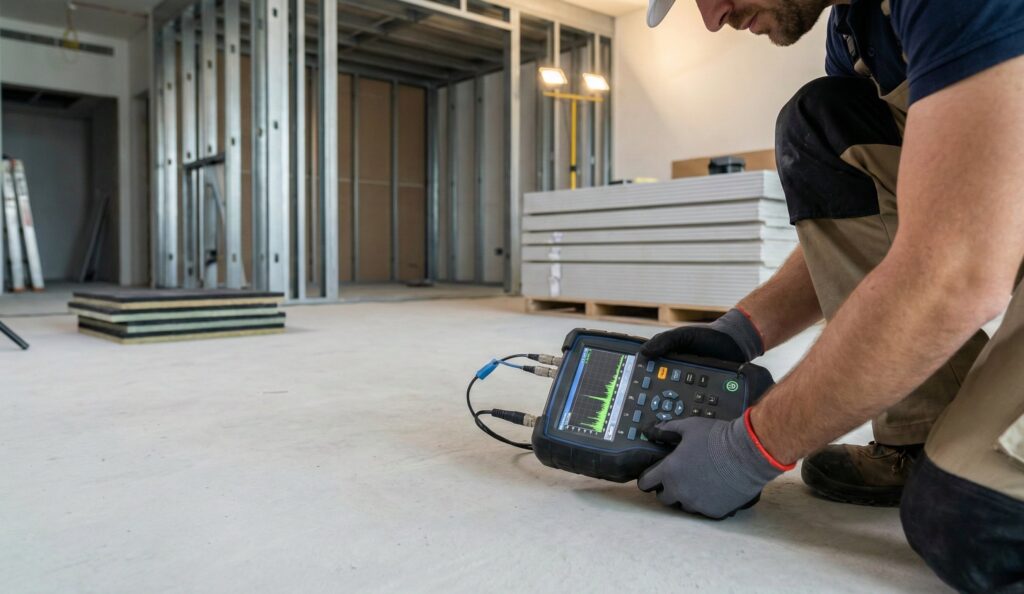
We specify closed-cell, cross-linked polyolefin foams or EPDM (ethylene propylene diene monomer) isolators. These are not just materials; they are engineered systems with documented, long-term chemical stability and near-zero creep (<2% over 50 years under maximum load). Their performance is not a variable; it’s a constant. This shifts the entire financial model from a CapEx followed by recurring OpEx to a single, slightly higher initial CapEx that delivers a maintenance-free, 25-year performance guarantee. It’s the only logical approach. This principle extends to every component. Instead of standard sealants that dry, shrink, and crack, creating new flanking paths within 2-3 years, we mandate non-curing butyl or silicone-based mastics with high movement capability (±25%), ensuring the acoustic integrity of every joint and penetration remains intact for the asset’s entire life-cycle. This isn’t about building a quiet room; it’s about engineering a financially stable asset whose performance characteristics are predictable and guaranteed, thereby flattening the depreciation curve.
The Engineering Audit: Performance Specification Matrix
| Performance Metric | Standard Industry Practice (Dubai) | The Solomia Home Engineering Standard |
|---|---|---|
| Field-Tested Noise Isolation Class (NIC) – ASTM E336 | NIC 40-45 (Despite STC 55+ spec) | NIC 58+ (Verified On-Site) |
| Low-Frequency Attenuation (125Hz) | 18 dB | 35 dB |
| Mid-Frequency Attenuation (1000Hz) | 55 dB | 72 dB |
| Vibration Isolator Creep (% over 10 years @ 40°C) | 15-20% (Material Failure) | <1.5% (Chemically Stable EPDM) |
| Acoustic Sealant Volatility (VOC mg/m³) | >50 mg/m³ (Low-grade acrylic) | <5 mg/m³ (Zero-VOC Silicone/Butyl) |
| Resilient Channel Load Deflection Tolerance (mm) | +/- 1.5mm (Bridging Risk) | +/- 0.2mm (Precision Engineered) |
Practical Case: C-Suite Asset Recovery, Jumeirah Islands
We were engaged by a tech founder whose newly constructed villa in Jumeirah Islands had a critical functional defect. The low-frequency audio from the ground-floor home cinema, specifically in the 60-120Hz range, was rendering the first-floor master suite unusable. The structure-borne vibration was physically perceptible through the floor and the bed frame. The original contractor’s solution of adding more drywall had, predictably, failed. Our forensic acoustic analysis identified the primary flanking path: direct vibration transmission through the rebar grid within the concrete slab, which connects the two spaces. In practice, the entire slab was acting as a speaker cone.
The engineering response was surgical. We designed a full ‘box-in-a-box’ system for the cinema. This involved constructing a new room within the existing concrete shell, completely decoupled from the main structure. A floating concrete floor was poured over a grid of custom-calibrated elastomeric isolators, engineered to provide a system natural frequency of 8Hz, well below the problematic audio frequencies. The walls were framed on isolation rails, and the ceiling was suspended from neoprene hangers. The result was a 24dB reduction in noise transmission at 80Hz in the master suite. The asset was not just repaired; its utility was fundamentally restored, directly impacting its livability and market valuation.
Frequently Asked Questions
How do you quantify the ROI on advanced acoustic engineering?
The calculation is direct. First, we model the Life-Cycle Cost (LCC) by eliminating the predictable 5 to 7-year remediation cycle required for standard installations, which represents a significant OpEx saving. Second, we factor in asset utility; a space that is functionally compromised by noise has a lower effective value. Third, for high-end properties, documented and guaranteed acoustic performance adds a quantifiable 3-5% premium to the resale valuation. The ROI is a composite of these three metrics, not an abstract concept.
Isn’t a high STC rating sufficient for specifying performance?
No. It’s a dangerously misleading metric in isolation. STC (Sound Transmission Class) is a laboratory rating for a perfectly constructed, perfectly sealed partition. It has zero bearing on real-world performance once installed in a complex building with flanking paths. We operate exclusively on field-tested metrics, such as NIC (Noise Isolation Class) and AIIC (Apparent Impact Insulation Class), which measure the final, as-built performance of the entire system. An STC 60 wall can easily perform at NIC 45 if flanking is not neutralized. The lab number is irrelevant.
What is the single most common failure point in modern villa acoustic designs in Dubai?
It’s a tie between two critical oversights. First, unsealed or improperly sealed MEP penetrations through walls and floors. Second, the direct mechanical fixing of interior finishes to the primary structure—for example, screwing drywall studs directly to a concrete slab or block wall. Both create a highly efficient, rigid bridge for structure-borne vibration to bypass any and all insulation. It’s a fundamental error in physics.
How does Dubai’s climate specifically impact the choice of acoustic materials?
The impact is severe and dictates material selection. Extreme thermal cycling causes significant expansion and contraction in building materials. A low-grade acrylic or caulk-based acoustic sealant will harden, crack, and fail within two seasons, creating dozens of new flanking paths. High ambient humidity and UV exposure, even indirect, will degrade the polymer chains in cheap neoprene or open-cell foams, causing them to lose their elasticity and damping properties. Therefore, we exclusively specify materials with a proven operational temperature range of -20°C to 120°C and inherent chemical stability, such as inorganic silicone-based sealants and cross-linked EPDM isolators, to guarantee zero performance degradation over the asset’s lifecycle.